
Healthy Fascia
This morning I stumbled upon a document talking about fascia and hEDS patients. It was quite an interesting read. This is an area is often overlooked by doctors when EDS patients talk about their pain. When a doctor does an x-ray, they’re only looking at the bones. An MRI, looking at the tendons and ligaments. There isn’t a standard test to look at the fascia, the one thing that protects our bones, ligaments, tendons and nerves.
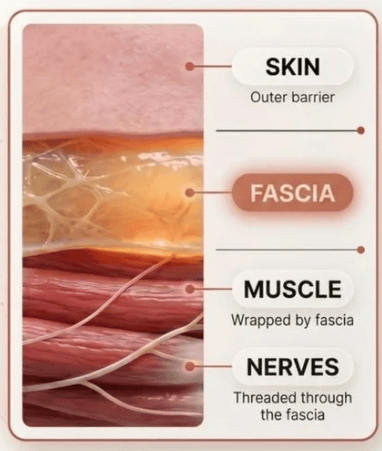
In a healthy body, fascia looks like the picture above. It surrounds every joint, it’s a smooth, slippery cushion that protects everything it wraps around. The fascia doesn’t have any feeling of pain, aches… It stays soft and full of water.
Dehydrated Fascia
Many EDS patients wake up feeling weighed down, stiff, and unrested. The fascia is the one area of my body that is not loose, flexible or super bendy.
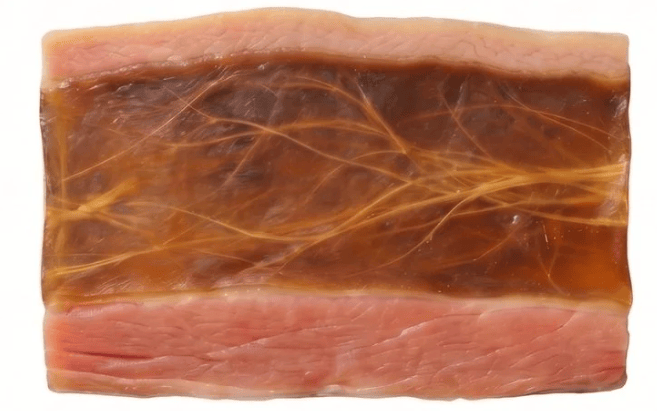
The job of collagen in your fascia is to stay soft, hold water and nutrients. Unfortunately, the opposite is happening with hEDS. The fascia becomes thick and hard, making it difficult to move. Everything running through the fascia has now become constricted. The muscles and nerves are compressed. Everything stiffens up over night making it difficult to spring up out of bed in the morning. Blood vessels that run through are narrowed.
Because my body never fully gets to rest and recover, is why I am in constant pain. I called to make an appointment with a new pain management doctor. I was told he treats the body as a whole, not just specific joints. When I called to make my appointment, his receptionist asked for a specific area. I explained I have hEDS and that my pain is everywhere. After being put on hold, I still had to give her a primary point. No worries, it’s just a starting point.
Exhaustion
Every night, it is a struggle for me to go to sleep. It is very hard for me to find a comfortable position. Add a snoring husband and dog, forget about a solid nights sleep. I have taken gummies to help with sleep, been prescribed various sleep meds that don’t work, tried Advil PM and Z-Quill. The first night they help, but take it a second night and I am back to struggling.
This morning I had my second appointment with an Osteopath. I talked to him about the article I had read, he confirmed that yes, hEDS patients do tend to have a dehydrated fascia, one more reason to drink at least 4 liters of water each day. During the appointment he did more manual manipulation on my legs, hips, and back. He found multiple muscle spams happening all up and down my body. He also found that a rib on the left side gets stuck when I inhale and a rib on my right gets stuck when I exhale. I knew that I have a few on my left that dislocate when I turn while seated, had no clue about the ones getting stuck.
The doctor told me that he can only do one more round of the manual manipulation. This paired with the Prolotherapy should work together to help my labral tear in my hip heal. No guarantee given that there’s a low blood supply to the ligament. Something I need to consider is if I want to try MITT. It is high-energy magnetic pulses that go into the affected area. There’s no guarantee that it will repair the torn ligament but it is promising. The pulses will target the area that needs healing. It is a total of 8 sessions, with no side effects, out-patient and of course, out of pocket. This could work together with the Prolotherapy, causing an irritation to the body making it heal itself.
After our appointment I came home wondering why I was so tired. I didn’t think that all the manipulation he was doing was making my body heal itself. My brain needed time to process the new position my joints were put in, muscles and tendons were in the process of repairing. This is what healing feels like. Now it’s time to research MITT.
Medical Disclaimer: I am sharing my personal journey, daily management strategies, and lived experiences with Hypermobile Ehlers-Danlos Syndrome for informational and community-building purposes only. I am not a doctor, physical therapist, or medical professional. The content on this blog is not a substitute for professional medical advice, diagnosis, or treatment. Always consult with your healthcare team before making changes to your medical care, exercises, or lifestyle routines.


Leave a Reply