

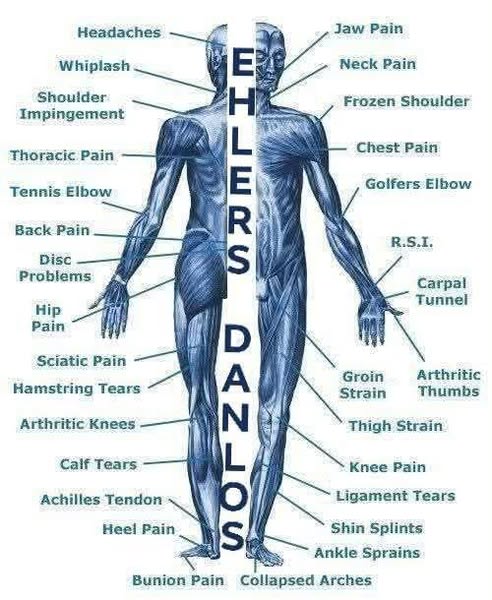
Living with Ehlers-Danlos Syndrome (EDS) often feels like balancing two distinct realities: the dynamic, complex symptoms happening inside my body, and the “you look totally fine” narrative projected by the outside world.
What People Don’t See When They Look at EDS
If you passed me in the grocery store today, you probably wouldn’t notice a thing. You wouldn’t see the kinesiology tape hidden under my sweater, the subtle adjustments I’m making every two minutes just to keep my hips from sliding out of place, or the mental math: If I put these groceries away now, am I going to be completely wiped out by dinner? That’s one of the reasons my husband does the grocery shopping. It started after my first wrist surgery. I was struggled to push the cart and the people standing in the middle of the aisle not budging while I struggled to push the cart with one hand around them, frustrated me so much.
To anyone watching, I look totally normal. But inside, my connective tissue is basically operating like worn-out elastic.
That’s the dilema of living with EDS: so much of the struggle is completely invisible. And living in a body that hides its own glitching comes with a whole extra level of mental and physical challenges and fatigue.
But You Don’t Look Sick
Because EDS impacts collagen—which is basically the glue holding us together—it touches everything from joints and skin to heart rate and digestion. But unlike a broken leg wrapped in a colorful cast, subluxations, dizzy spells, weakening joints from sitting and standing too long don’t show up on the outside.
People see me out walking fine on Tuesday, and then stuck in bed or using a cane on Thursday, and they get confused. Feeling okay at 10 AM doesn’t mean your body won’t hit a wall by 2 PM, and that doesn’t mean you’re making it up. It has been suggested I start to use a cane for shopping and long days on my feet and walking the dogs. I have struggled with the idea of using one until recently. I began to notice my ankle rolling, one event sent me flying and I almost went face first into a stone wall. Thankfully, I was able to grab hold of the car to catch myself.
The Mental Energy Nobody Talks About
The absolute hardest part isn’t always the physical pain—it’s the endless background noise running in my head 24/7:
- The micro-calculations: Is this chair going to pop my ribs out? How long can I sit here before my back acts up? Where can I sit down if my heart starts racing and I get hit with a dizzy spell?
- The masking: Pushing through a meeting or social event with a smile while ignoring five different joint aches, putting all my energy into feeling totally fine.
- The gaslighting: Trying to explain your symptoms when every blood test and X-ray comes back looking “normal.”
Owning My Reality
Here’s the thing I’ve had to learn the hard way: If I need a cane today and don’t need it tomorrow, that’s valid. If I look great on the outside but need to lay down on the floor right now, that’s valid too. My body’s reality is real, whether anyone else can see it or not.
I struggled with the idea of getting a handicap placard for my car. A friend had suggested it and then a doctor. It wasn’t until I went for a quick trip to Target that I realized I would have used it that day. By the time I got into the store I was ready to head back to my car. I was exhausted, my body tightened up and the thought of walking through the store seemed impossible. A quick application and signature from my primary, I had the placard 2 weeks later. If I find a spot next to a handicap spot I opt for that and leave the spot for someone who may need it more. I’ve had the placard for about 2 months now and have only felt the need to use it once.
As part of the mental running, I fear that someone is going to question my need to park there. Is it any of their business, NO. But it’s still a fear of mine.
Understanding
The biggest gift you can give me and anyone else living with EDS is simply taking our word for it.
- Believe us when we say we’re in pain or exhausted, even if we were laughing a minute ago.
- Don’t take it personally when plans change last minute. Flares don’t check our calendars first.
- Keep in mind that “looking good” doesn’t mean “feeling fixed.” We love a good compliment, but looking put-together often just means we put a lot of effort into masking that day!


Leave a Reply